
Insights
North America’s Supply-and-Demand Showdown
Insights

Installing submarine transmission cables: when the best way across is under

Around 700,000 miles of high-voltage transmission lines crisscross the continental US, connecting power generation with the substations and distribution points that, in turn, deliver electricity to users. That’s enough wire to go around the Earth 28 times. While most transmission lines are the cables you see running between tall towers and poles, a significant number run underground or underwater.
Among these, underwater cables – which are technically known as submarine cables – present some of the most intriguing installation processes. Laying submarine cables combines the challenges of both above ground and underground cables with the added dimension of working underwater. Just as on land, there can be hills, valleys, and challenging terrain to traverse – plus whatever may have sunk to the bottom over the years. And since many submarine cables are buried at the bottom, there are many of the same considerations that come with underground cables. All of these factors are mysteries hiding beneath the surface.

Finding what lies beneath the surface
When the best way to route electrical power transmission across a body of water is under the water, the first step is answering those mysteries. Just as with above-ground installation, conducting surveys and studies gives engineers a picture of the terrain. They use these to determine the best route and method to get from one side to the other.
Engineers map the underwater landscape using high-tech equipment such as side-scan sonar and multibeam sounding systems, some of the same tools used by explorers to find shipwrecks. These technologies help identify obstacles – such as sunken vessels, boat anchors, large logs, or rocks and boulders – that could damage equipment.

Geotechnical studies provide detailed information about the riverbed or seafloor sediment and soil. In addition, different soil types, such as soft sand, hard clay, or rocky, each present their own challenges.

Image sourced from: Resner, Leszek, and Sandra Paszkiewicz. 2021. “Radial Water Barrier in Submarine Cables, Current Solutions and Innovative Development Directions” Energies 14, no. 10: 2761. https://doi.org/10.3390/en14102761
Submarine cables: more than wire
Taking high-voltage electricity underwater requires special insulated and armored cables. Unlike above-ground transmission lines, which rely on air for insulation, submarine cables require thick insulation. Another layer of armoring supports the cable and protects the cable from damage by such things as anchors and fishing gear, or from the abrasion of sand and sediments carried by currents. The combination of insulating and armoring increases the cable width to about six to 11 inches in diameter – much wider than the above-ground versions.
Preparing and installing the submarine cables
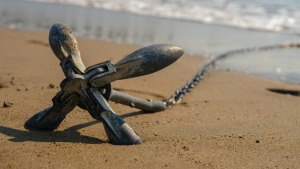
Before the cable is laid, it is important to conduct pre-construction activities. For example, a pre-lay grapnel run clears the route to ensure a smooth installation process. The grapnel, which looks like an anchor with multiple hooks, is dragged across the bottom to clear the cable route of rope, anchor line, logs, or other large objects that could damage the equipment or cable.
Simple cable lay
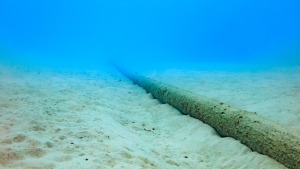
In deeper water, where there’s no risk of damage from boat anchors, fishing equipment, or vessels, the cable can rest directly on the bottom, much like a giant extension cord. Specially designed vessels or barges carry the spools of cable, unrolling them like fishing line.
Buried cable: digging down for protection
Most of the time, though, submarine cables are buried to protect them. Mechanical plows and jetted systems stand as the two most common methods for burying cables. Both systems are mounted on sledges with skids that are pulled across the surface by a barge. This ensures the cable is buried to a consistent depth regardless of water depth or bottom contours.
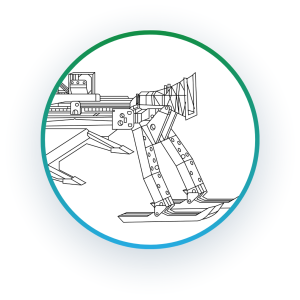
Mechanical trenching plow: The basic concept behind the mechanical plow has changed little from when farmers would use a mule, horse, or ox to pull a plow through their fields: a blade slices a narrow furrow into the soil. But the similarity ends there. The dedicated tools used to excavate a trench and bury the marine cable are much more complex. The plow is mounted to an underwater sled that is towed behind a barge and slides over the bottom on skids. The cable is fed through the sled and laid behind the plow. The plow lifts a wedge of sediment in front of the cable, and the cable is inserted below the wedge. Variations of this tool include chain or wheel cutters for excavating rocky soils. The cable is then covered with the sediment that was displaced by the plow.

Jetted systems: With jetted systems, the physical plow is replaced with water jets that fluidize the soil. The jet-plow sled can work across a wide range of conditions, including marshes, tidal zones, and deep water. A variation on the jet plow is vertical injection. The vertical injection tool, which looks a bit like a giant golf club, is mounted to the stern of the vessel carrying the cable and used when deeper burial depths are required. The cable is fed vertically down through the tool, along with the pipes for the pressurized water. The fluidized sediment then falls back into place, covering the cable.
There are also hybrid systems for undersea cables that combine the two technologies – water jets fluidize sand and clay ahead of the jet-plow. Some of these systems also have a cutting tool for hard clay or other conditions that are difficult for plows or jets.
Why it matters
These are just a few of the technologies available for underwater cable installations. Each is designed for specific conditions, including water depth and bottom conditions, as well as tides and currents. Our engineers and environmental experts also take into account marine traffic and other marine activity, along with protecting the environment, as well as cost and timing, to come up with the best feasible solution. However the cable is installed, the end result is the same: a stronger, more resilient, and reliable grid to deliver the power consumers need now and in the future.
Founded in 1990, LS Power is a premier development, investment, and operating company focused on the North American power and energy infrastructure sector, with leading platforms across generation, transmission and energy expansion solutions. Since inception, LS Power has developed or acquired 50,000 MW of power generation, including utility-scale solar, wind, hydro, battery energy storage, and natural gas-fired facilities. Through its transmission business, LS Power Grid, the company operates 7 transmission utilities, has built 780+ miles of high-voltage transmission with another 400+ miles currently in construction or development. LS Power actively invests in and scales businesses that are meeting the growing needs of the energy expansion, including electric vehicle charging, demand response, microgrids, renewable fuels and waste-to-energy platforms. Over the years, LS Power has raised more than $76 billion in debt and equity capital to support North American infrastructure. For information, please visit www.lspower.com.
